
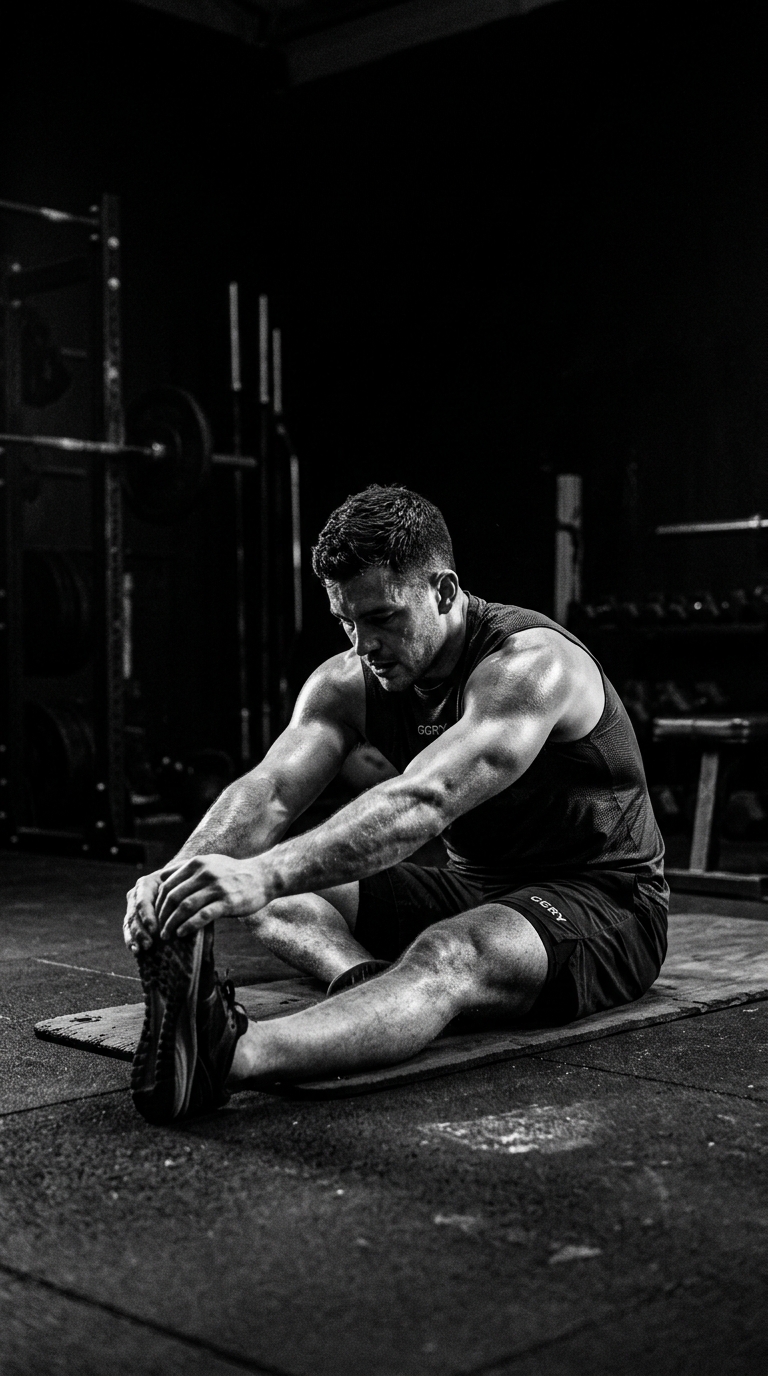
Nobody gets stronger in the gym. The gym is where you sign the bill. The muscle fiber tears, the nervous system fries, the joints take the pounding. Adaptation happens later, when you're not looking, when you're asleep or sitting still or doing nothing that looks like progress. Treat recovery like an afterthought and you're not training harder than everyone else. You're just digging a hole and calling it a program.
Sleep is non-negotiable. During deep sleep, growth hormone release spikes, tissue repair accelerates, and the nervous system consolidates motor learning from the day's work. Drop below 7 hours consistently and studies show strength output, reaction time, and glycogen resynthesis all take a hit. Six hours of sleep and eight hours of sleep are not the same training tool. One builds you. The other slowly dismantles what you built yesterday. Protect the last hour before bed — no screens blasting blue light into your eyes, cool room, consistent wake time even on off days. Sleep is not a reward for hard training. It's the mechanism that makes hard training worth anything.
Deloads aren't weakness. They're maintenance on the machine. Every 4 to 6 weeks, depending on volume and intensity, drop total load by 40 to 60 percent for a week. Keep the movement patterns, strip the grind. This isn't about getting soft. It's about letting connective tissue catch up to muscle — tendons and ligaments adapt slower than muscle fibers, and that mismatch is where injuries live. Skip deloads long enough and the body deloads you. Usually with a tweak that costs six weeks instead of one.
Mobility work isn't stretching for the sake of feeling bendy. It's maintaining the range of motion your training actually demands. A squat needs hip and ankle mobility. A bench needs thoracic extension and shoulder capsule health. If you're missing range, you compensate somewhere else, and compensation under load is how small problems become real injuries. Ten minutes a day on the joints you abuse most — hips, ankles, shoulders, thoracic spine — beats an hour of generic stretching nobody sticks with. Specific beats thorough every time.
Fatigue management comes down to telling the difference between soreness and damage. Soreness is normal. It fades in 48 to 72 hours and doesn't affect bar speed or range of motion. Real fatigue shows up as flat performance on lifts that should be easy, elevated resting heart rate, irritability, and sleep that doesn't feel restorative no matter how many hours you log. Track resting heart rate or HRV if you want data. Track how the bar moves if you don't. Either way, fatigue that doesn't respond to a normal night's sleep is a signal, not a mood.
Readiness is why autoregulation exists. Not every day deserves the same number on the bar. Use RPE — rate of perceived exertion — to adjust load in real time. If your programmed 8 feels like a 9.5, that's data. Drop the weight 5 to 10 percent and hit your reps clean instead of grinding a number that was never guaranteed in the first place. Readiness isn't about babying yourself. It's about training the body you actually have today, not the one from your best session three weeks ago.
Recovery isn't the opposite of training. It's the other half of the same equation. Lift without respecting sleep, deloads, mobility, and fatigue signals, and you're running a program with half the inputs missing. The work builds the stimulus. Recovery cashes the check. Skip the second half and eventually the body sends the invoice itself — usually at the worst possible time, usually with interest.